

Some places are so extraordinary that once you experience them, you can’t help wanting to return. For me, the Grand Canyon is one of those places.
I first kayaked through the canyon in 2018 as part of a Team River Runner (TRR) expedition, guiding five blind military veterans. Whenever I mentioned to my wife that I wanted to return someday, her response was, “Well, you’d better do it soon,” meaning I wasn’t getting any younger. She was right, of course. At 72, I still feel there’s plenty of whitewater paddling left in my tank, so I signed up for a September 2026 kayaking trip. I was joined by two kayaking buddies from Wisconsin – Josh and Dave – along with two Team River Runner friends from California – Carlisle and Maggie.
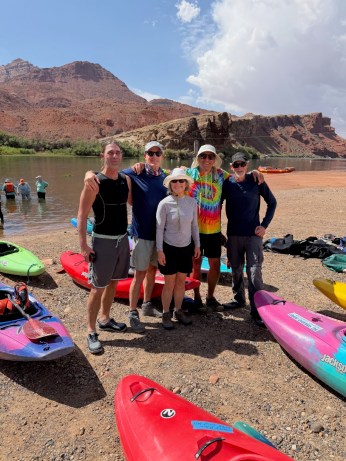
This was a kayak-centric, raft-supported trip. The total group included 26 paying guests, four river guides from Arizona Raft Adventures (AzRA), and two kayak guides from Current Adventures. While motorized rafts carried our camping gear, food and other supplies, most of us paddled either hard-shell or inflatable kayaks, commonly called “IK’s” or “duckies.” Some kayakers opted for raft rides when we encountered the biggest rapids. (Or in my case, when we needed a rest day. More about that below.)
For 14 days, we’d make our way down the Colorado River, surrounded by some of the most spectacular scenery on Earth. And as it turned out, we’d have plenty of adventure along the way.
A Dramatic Beginning
Our trip got off to an unexpected start even before we launched.
When our bus from Flagstaff arrived at the Lee’s Ferry put-in on August 30, we learned that the previous day’s heavy monsoon rainfall over a North Rim burn area had sent a massive wall of water and debris crashing down Bright Angel Creek and through Phantom Ranch, about 88 miles downriver from us. The flood destroyed footbridges and other infrastructure, and triggered helicopter evacuations for more than 80 people. We heard later that three hikers in that area had tragically lost their lives.
For several hours, we waited in a heavy downpour at Lee’s Ferry, uncertain whether the National Park Service would allow our trip to proceed. It was a sobering reminder that the Canyon, for all its beauty, can be an unforgiving environment. Finally, shortly after noon, NPS gave us the go-ahead. After months of anticipation, I was once again paddling the Colorado.
The River Had Some Surprises
One of the biggest differences between my two Grand Canyon trips was the river flow.
In 2018, the Colorado was running at approximately 10,000 cubic feet per second (CFS). This time, flows were generally between 6,000 and 7,000 CFS. You might think less water would mean easier rapids. In fact, I found most of the rapids more difficult this time. Our trip leader, Jared, who has 22 years of experience guiding in the Grand Canyon, described the waves at these lower flows as “sharper.” That was a pretty good description. The waves seemed steeper, more abrupt and less forgiving than I remembered. The water was unusually warm and extremely silty.
Early on I had a mishap in Tiger Wash Rapid (also known as 27-Mile Rapid). I flipped and when I set up to roll, I twisted my elbow. For the rest of the trip it continued to hurt. Thomas suggested I ride on a raft to give it some rest. I eventually took his advice, spending a day on a raft before returning to my kayak for several days. Later in the trip, I gave it another day off. Having paddled all 226 miles back in 2018, I didn’t have anything to prove this time around. Taking care of my body seemed more important.
I paddled most of the rapids upright. In others I rolled up after capsizing. But I also had four swims during this trip, compared to just one in 2018. As the saying goes, “We are all between swims.” Apparently, I was overdue for a few. Kayak guides Thomas and Kim were quick to respond, helping me get safely to shore each time.
The Colorado has a way of reminding you that it deserves respect.
Helicopter Evacuations
No roads lead down to the river between the Lee’s Ferry put-in and the Diamond Creek take-out 226 miles downriver. When something serious happens, getting help is no simple matter. Jared told us that during his 22 years of guiding in the Grand Canyon, someone needed a helicopter evacuation only once every four years or so.
We had two helicopter evacs on this trip.
The first happened on just our second day when one of our ducky paddlers capsized in a rapid and broke a bone in her knee. Our guides used a satellite phone to call for assistance. First to arrive were two National Park Service rangers in a motorized raft. They assessed the situation and called for a helicopter, which arrived a few hours later.
The second evacuation happened the following week, and this time it was for one of our kayak guides who injured his shoulder in a challenging rapid. Seeing helicopters deep in the Grand Canyon was a powerful reminder of how things can happen to anyone, and just how remote we were.

Life in the Canyon
A Grand Canyon river trip is much more than non-stop adrenaline. Each day brought a new stretch of spectacular scenery, with towering canyon walls, constantly changing colors and geological formations that seemed almost impossible to comprehend. We traveled through a wild and untamed landscape shaped over millions of years.
Even though there are more than 80 named rapids, most of the 226 miles are relatively flat. However, you also encounter a lot of frustrating, swirling current. And then there’s the wind. For some reason it’s always a headwind, never a tailwind.
One of our river guides shared a saying that perfectly captured life in the canyon: “You have to get comfortable with being uncomfortable.” At camp, sand got into everything. The heat was often intense, especially off the water. Some days, temperatures climbed above 100 degrees. Nighttime didn’t always bring relief. On some nights, sleeping was borderline miserable.
One of preparation I made for this trip was to bring a small USB-powered fan. On the hottest nights, I hung it inside my tent, doused my cotton shirt with water and aimed the fan at my face and chest. It made a big difference.
I also brought a 40-watt solar panel and two power packs, which let me recharge the fan and other electronic devices during the trip; most importantly my continuous glucose monitor (CGM) receiver, which I rely on to manage my diabetes.
Another upgrade over my 2018 trip was being able to text Mary each evening using my satellite-connected iPhone. This was reassuring for her, especially after she heard about the flash flood at Phantom Ranch. Several other guests also had satellite texting. We were asked to be discreet and not share news from the outside world with the group. I understood the reasoning. One of the great pleasures of a Grand Canyon river trip is the opportunity to disconnect from the constant stream of news, messages and distractions that fill our everyday lives. For 14 days, our world was largely reduced to the river, the canyon, the weather and the people traveling with us. Still, I appreciated being able to let Mary know each day that I was fine.
Our days developed a rhythm: wake up at daybreak, enjoy a delicious breakfast, break camp, help load the rafts, paddle downstream, stop for lunch and maybe a hike into a side canyon, run more flat water and rapids, find another amazing place to spend the night, unload the rafts, set up camp, savor a delicious dinner and enjoy a night under brilliant stars. Most evenings everyone was bedded down by 8:30 or 9.


The People Make the Trip
I started this trip with four friends I invited to join me. Our little circle of “badass boaters” (as we jokingly called ourselves) expanded right away. Smaller circles of friends blend into one larger group. We had an interesting mix of personalities and backgrounds. Most of the paddlers were women. Abilities and experience varied, but everyone shared an enthusiasm for adventure and challenge. Without the usual distractions of everyday life, conversations come easily. Everyone pitches in, looks out for one another and shares in each day’s adventures.
There’s no shortage of things to talk about at the end of a day on the river. Some of the best moments weren’t necessarily the most exciting ones. There were conversations and laughter in camp, shared meals and quiet times when we could simply sit and appreciate where we were. By the end of the trip, we grew to know each other better through these shared experiences.
Away From It All
There’s an appealing simplicity to life on a river trip. You wake up each morning knowing the day’s journey will take you somewhere new. You don’t have to think about traffic, appointments or obligations waiting at home. Your attention is focused on what’s immediately around you: the current, the weather, the canyon and your companions.
When I think back on this trip, I’ll certainly remember the rapids. I’ll remember the excitement of success through huge waves, the frustration of four swims and the gratitude I felt for the help of our river guides. I’ll remember the heat, the beautiful and refreshing side canyon hikes, the helicopter evacuations, the spectacular views, and how surprisingly good a warm beer can taste at the end of the day.
But those aren’t the memories that best capture what this trip meant. What stays with me most is the experience of living in the Grand Canyon for two weeks. It’s difficult to describe the feeling of being surrounded by those immense canyon walls, watching the light change their colors throughout the day, exploring places accessible only from the river, and sharing it all with a group of strangers who became friends.
I feel fortunate to have experienced the Grand Canyon from a kayak not once but twice. My 2018 trip will always hold a special place in my heart because of the remarkable veterans I shared it with. This year’s trip was different but every bit as spectacular. I’m grateful for the opportunity, the friendships, the adventure and the memories.
And yes, even the swims.
